science | hahaha | |
technology | WI-FI |
|
economy |
yodaaaa
yodaaaa
Assignment 1.5 – Composition & Photography
Each student is to take a series of photographs that emphasize a particular element of composition theory. These photos, with descriptions, are to be arranged in a word document, and this one file is handed in as assignment 1.5 (not individual pictures).
No photograph is to be shared by students (or similar subject or object of focus); it will be all individual work (although you will share the camera time).
Select and describe (why you think it is good) your photograph taken for each of the following elements:
That’s 8 pictures in total with good descriptions. Remember, aesthetic judgment on pictures varies (what one person may like another does not), so your descriptions detailing why you value your picture is worth just as much as the photograph.
NOTE: At the minimum, the first two full days with a camera and at least three photos must be taken in the classroom. Once you are comfortable with the use and care of the cameras, with permission, you may take the remainder of the photos within the school (not outside the school, not disturbing other classes).
Stake Holder Matrix (Groups): | Finance | Environment | Legislation | Reputation |
Suppliers | ||||
Local Residents | ||||
Provincial Government | ||||
Municipal Government | ||||
Contractors | ||||
Local Authorities | ||||
Costumers |
Stake Holders Map
SWOT Analysis
Strengths
| Weaknesses
|
Opportunities | Threats |
Stakeholders Map
Stake Holder Matrix (Groups): | Finance | Environment | Legislation | Reputation |
Suppliers | D | A | A | A |
Local Residents | A | A | A | A |
Provincial Government | C | C | B | D |
Municipal Government | D | D | B | D |
Contractors | D | D | D | C |
Local Authorities | D | D | D | D |
Costumers | D | C | C | C |
Staff | D | A | A | D |
Group A - Low interest/low power
Group B - High interest/ low power
Group C - Low interest/ high power
Group D - High interest/ high power
DiCaprio in 2025 | |
Born | Leonardo Wilhelm DiCaprio November 11, 1974 (age 51) Los Angeles, California, U.S. |
Occupations |
|
Years active | 1989–present |
Organizations |
|
Works | |
Title | United Nations Messenger of Peace (designated 2014) |
Father | |
Awards | |
Website | |
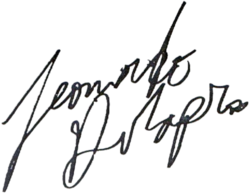
Signature | |
Born in Los Angeles, DiCaprio began his career in the late 1980s by appearing in television commercials. He had a recurring role in the sitcom Parenthood (1990–1991), and had his first major film part as author Tobias Wolff in This Boy's Life (1993). He received critical acclaim and his first Academy Award nomination for playing a developmentally disabled boy in What's Eating Gilbert Grape (1993). DiCaprio achieved international stardom with the star-crossed romances Romeo + Juliet (1996) and Titanic (1997). After the latter became the highest-grossing film in the world at the time, he reduced his workload for a few years. In an attempt to shed his image of a romantic hero, DiCaprio sought roles in other genres, including the 2002 crime dramas Catch Me If You Can and Gangs of New York; the latter marked the first of his many successful collaborations with director Martin Scorsese.
DiCaprio continued to gain acclaim for his performances in the biopic The Aviator (2004), the political thriller Blood Diamond (2006), the crime drama The Departed (2006), and the romantic drama Revolutionary Road (2008). He later made environmental documentaries and starred in several high-profile directors' successful projects, including the thrillers Inception and Shutter Island (both 2010); the western Django Unchained (2012); the romantic drama The Great Gatsby (2013); the biopic The Wolf of Wall Street (2013); the survival drama The Revenant (2015), for which he won the Academy Award for Best Actor; the comedy-drama Once Upon a Time in Hollywood (2019); the crime drama Killers of the Flower Moon (2023) and the action film One Battle After Another (2025).
DiCaprio is the founder of Appian Way Productions—a production company that has made some of his films and the documentary series Greensburg (2008–2010)—and Leonardo DiCaprio Foundation, a nonprofit organization devoted to promoting environmental awareness. A United Nations Messenger of Peace, he regularly supports charitable causes. In 2005, he was named a Commander of the Order of Arts and Letters for his contributions to the arts, and in 2016, he appeared in Time magazine's 100 most influential people in the world. DiCaprio was voted one of the 50 greatest actors of all time in a 2022 readers' poll by Empire magazine.
Contents
What's Eating Gilbert Grape (1993). achiePortal:Philosophy
Tools
From Wikipedia, the free encyclopedia
Portal topics - (Random portal)
ActivitiesCultureGeographyHealthHistoryMathematicsNaturePeoplePhilosophyReligionSocietyTechnology
The Philosophy PortalA portal for Wikipedia's philosophy resources • 17,875 articles in English The Thinker, a statue by Auguste Rodin, is often used to represent philosophy. Left to right: Plato, Kant, Nietzsche, Buddha, Confucius, Averroes Philosophy (from Ancient Greek philosophía lit. 'love of wisdom') is a systematic study of general and fundamental questions concerning topics like existence, knowledge, mind, reason, language, and value. It is a rational and critical inquiry that reflects on its methods and assumptions. Historically, many of the individual sciences, such as physics and psychology, formed part of philosophy. However, they are considered separate academic disciplines in the modern sense of the term. Influential traditions in the history of philosophy include Western, Arabic–Persian, Indian, and Chinese philosophy. Western philosophy originated in Ancient Greece and covers a wide area of philosophical subfields. A central topic in Arabic–Persian philosophy is the relation between reason and revelation. Indian philosophy combines the spiritual problem of how to reach enlightenment with the exploration of the nature of reality and the ways of arriving at knowledge. Chinese philosophy focuses principally on practical issues about right social conduct, government, and self-cultivation. Major branches of philosophy are epistemology, ethics, logic, and metaphysics. Epistemology studies what knowledge is and how to acquire it. Ethics investigates moral principles and what constitutes right conduct. Logic is the study of correct reasoning and explores how good arguments can be distinguished from bad ones. Metaphysics examines the most general features of reality, existence, objects, and properties. Other subfields are aesthetics, philosophy of language, philosophy of mind, philosophy of religion, philosophy of science, philosophy of mathematics, philosophy of history, and political philosophy. Within each branch, there are competing schools of philosophy that promote different principles, theories, or methods. Philosophers use a great variety of methods to arrive at philosophical knowledge. They include conceptual analysis, reliance on common sense and intuitions, use of thought experiments, analysis of ordinary language, description of experience, and critical questioning. Philosophy is related to many other fields, such as the natural and social sciences, mathematics, business, law, and journalism. It provides an interdisciplinary perspective and studies the scope and fundamental concepts of these fields. It also investigates their methods and ethical implications. (Full article...) |
ved international stardom with the star-crossed romances Romeo + Juliet (1996) and Titanic (1997). After the latter became the highest-grossing film in the world at the time, he reduced his workload for a few years. In an attempt to shed his image of a romantic hero, DiCaprio sought roles in other genres, including the 2002 crime dramas Catch Me If You Can and Gangs of New York; the latter marked the first of his many successful collaborations with director Martin Scorsese.
DiCaprio continued to gain acclaim for his performances in the biopic The Aviator (2004), the political thriller Blood Diamond (2006), the crime drama The Departed (2006), and the romantic drama Revolutionary Road (2008). He later made environmental documentaries and starred in several high-profile directors' successful projects, including the thrillers Inception and Shutter Island (both 2010); the western Django Unchained (2012); the romantic drama The Great Gatsby (2013); the biopic The Wolf of Wall Street (2013); the survival drama The Revenant (2015), for which he won the Academy Award for Best Actor; the comedy-drama Once Upon a Time in Hollywood (2019); the crime drama Killers of the Flower Moon (2023) and the action film One Battle After Another (2025).
DiCaprio is the founder of Appian Way Productions—a production company that has made some of his films and the documentary series Greensburg (2008–2010)—and Leonardo DiCaprio Foundation, a nonprofit organization devoted to promoting environmental awareness. A United Nations Messenger of Peace, he regularly supports charitable causes. In 2005, he was named a Commander of the Order of Arts and Letters for his contributions to the arts, and in 2016, he appeared in Time magazine's 100 most influential people in the world. DiCaprio was voted one of the 50 greatest actors of all time in a 2022 readers' poll by Empire magazine.
Contents